.png)
.png)
.png)
Episode
#169
HEB
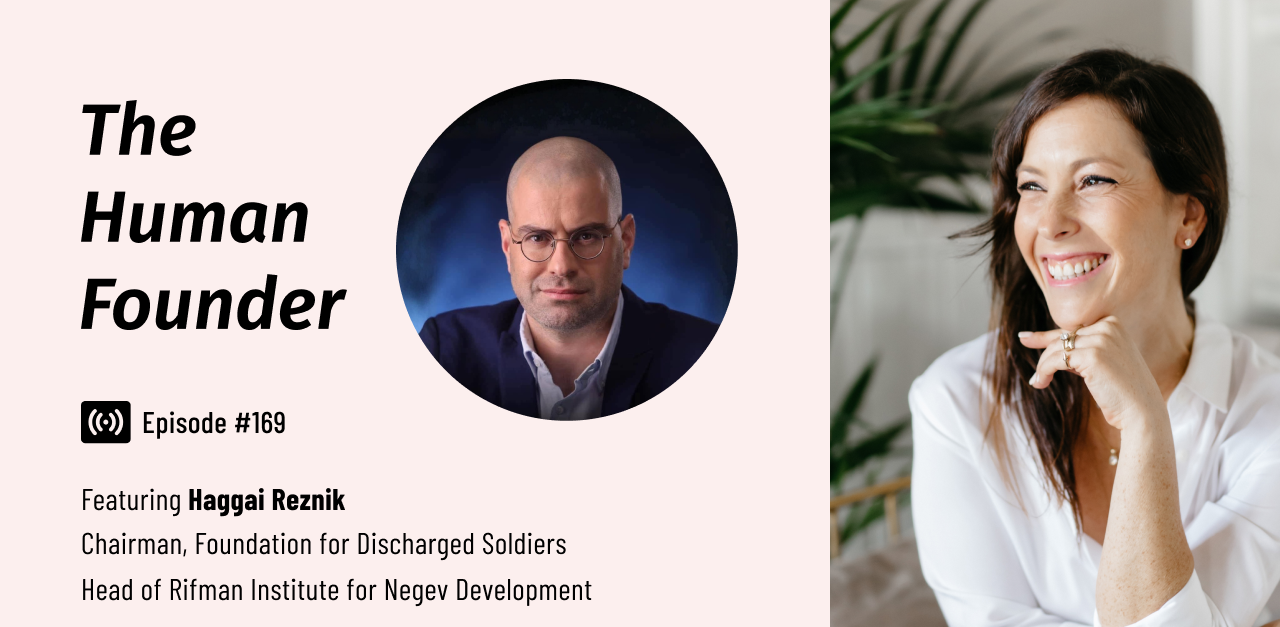
Haggai Reznik – From At-Risk Youth to National Entrepreneur: On Belonging, Self-Efficacy, and the Generation of Rebuilding
In this special, deeply moving episode released just ahead of Memorial Day, Independence Day, and the sharp transition between them - while we are still at the peak of a war, with or without a ceasefire - I host Haggai Reznik, the Chairman of the Fund for Discharged Soldiers in the Ministry of Defense, Head of the Rifman Institute for Negev Development, the former Director-General of the Ministry of Construction and Housing, and an author. But beyond the impressive titles, Haggai is an entrepreneur down to his core. His journey proves that entrepreneurship isn't just about founding tech startups; it’s a DNA. It’s the ability to create reality out of nothing, to take immense pain and hardship and transform them into creation and meaning. Our conversation flowed between his breathtaking personal story and the national mission he leads today with the generation of soldiers returning from the frontlines.
The "Outsider" Child: The Three Circles of Growth
Haggai’s story began in a complex, at-risk home in Jerusalem, from which he was removed by a court order at age 12 and sent to Kibbutz Revivim in the Negev. Out of a group of 20 youth, he was the only one who stayed (and eventually went on to become a member of the Kibbutz and even managed it). Haggai beautifully outlined three "circles of growth" that allowed him to survive and thrive, which are essentially the foundational building blocks of any founder:
- The Desire to Belong: Haggai shared how, on weekends, when everyone would leave the kibbutz, he would sneak back in. He would sit in his room and listen to the voices coming from the children's house of the local kibbutz kids, filled with a burning desire to belong to them. Without that internal drive, nothing would have happened.
- Self-Efficacy: Through a story about a Brazilian volunteer named Paulo Ricardo, who let him cut metal and drive a tractor as a kid, Haggai explained how critical it is to have just one adult who truly sees you, believes in you, and gives you the feeling that you are capable.
- Boundaries as Security: A youth counselor who gave him an ultimatum after he failed his classes pushed him to develop internal boundaries and discipline - a crucial muscle for anyone trying to succeed in an environment of extreme uncertainty.
"Believe in Yourself More Than Your Environment Believes in You"
During a lecture Haggai gave to at-risk youth, a nine-year-old girl asked him: "How do I become a CEO like you?" His answer captured the entire entrepreneurial mindset: Stop waiting for external validation. Founders, just like Haggai in his youth, must believe in their vision and themselves far more than their environment (or investors, or the market) believes in them in the beginning. That is the strongest engine for growth.
The Generation of Rebuilding and Post-Traumatic Growth
In a part of the conversation dedicated to our soldiers - those returning from Gaza, Lebanon, the territories, and endless months of combat in mandatory and reserve duty - we discussed the complex reality of today's discharged veterans. We touched upon the deep fracture, the loss, and the physical and mental wounds, but also on the concept of Post-Traumatic Growth. These young men and women have touched death, saved lives, and managed immense crises. They are coming home with a massive search for meaning and a refusal to waste time on what doesn't matter. Haggai rightfully views them as the next leadership generation of Israel - in tech, economy, education, and society. Our role as an ecosystem is to be there for them, to provide them with entrepreneurial tools, and to allow them to build their future, and ours.
The Loneliness of the Founder (vs. The CEO's Chair) Another fascinating point raised in our conversation was the difference between holding a formal title (being an "organ" of the system) and being a "founder." Haggai candidly shared that in his government roles as Director-General of a ministry, while the work was crucial and impactful, the path was paved and the system embraced you. In contrast, with the Rifman Institute - which he built from scratch to create policy and regulation in the Negev - he experiences the familiar loneliness of the founder. It’s the loneliness of having to convince the world that something matters, creating something out of nothing, fighting for every step, and holding a vision that few can see at first.
Holding the Duality
We ended the conversation with a concept that resonates so deeply during these days in Israel: Duality. The ability to feel a sense of belonging while keeping "one foot outside" to maintain humility and modesty. The ability to ache to the depths of your soul on Memorial Day, yet find the strength to dream, dance, and create life on Independence Day. Haggai has a unique way of processing this duality and his complex journey: writing. He started writing at age 24, and today it serves as a therapeutic tool as well. Over the years, he has written no less than five books - two novels, two children's books, and a poetry collection - dealing with social gaps in Israel, children from complex backgrounds, and growth. His art reminds us all that entrepreneurship is an internal journey just as much as an external one, and that it is a DNA not reserved only for high-tech, but for anyone who wants to create change.