.png)
.png)
.png)
Episode
#165
HEB
Live Podcast: "Not Now" – Oren Kaniel on the Mosaic of Experience, the Beginner’s Mindset, and the Fuel of "No"
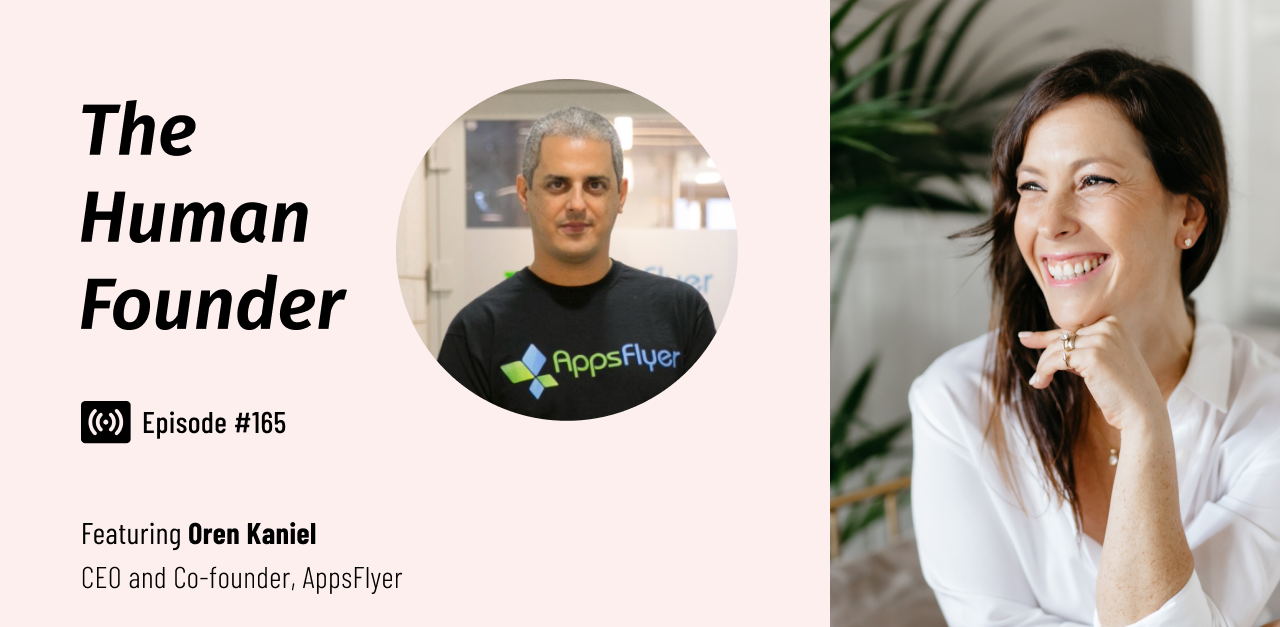
In this special live episode—recorded at the LeumiTech launch event for my new digital course, "The Human Founder," and my first for 2026—I sat down with Oren Kaniel, Co-founder and CEO of AppsFlyer. While Oren leads a global powerhouse that has surpassed the $500 million revenue mark, our conversation was anything but formal. In fact, judging by the audience's reaction in the hall, Oren should seriously consider a second career as a stand-up comedian rather than just a talented entrepreneur and CEO. Our talk didn't focus on numbers or scale; instead, we explored the man behind the title—someone who was genuinely moved to see his "younger self" from 14 years ago in the crowd, who believes we are each a mosaic of our experiences, and who knows exactly how to turn every "No" into the fuel that drives the engine forward.
From the Army Mess Hall to the Heart of the Ecosystem: A Mosaic of Experience
Oren’s path to entrepreneurship didn’t follow the typical "elite tech unit" trajectory. Growing up in Kiryat Motzkin, he was obsessed with computers from age zero, yet his military service found him in a completely different role: a cook. For years, he viewed this chapter as a missed opportunity, often avoiding questions about his service. Today, he realizes it was where the foundations of his leadership were laid. The kitchen taught him radical accountability—the realization that "if you don't show up, nobody moves." It taught him creativity with raw materials, the art of delivering a daily experience to people, and how to navigate a complex, high-pressure organization. For Oren, every experience—from discovering the internet as a kid and flying model airplanes as a childhood hobby to working as an unpaid intern at a VC in the U.S.—is a vital tile in the mosaic of a founder’s resilience.
Partnership, Marriage, and the Mental "Switch": Managing Harmony, Not Balance
A unique aspect of Oren’s journey is his partnership with Reshef, a high school friend, and Lisa, his life partner, who was instrumental in the company’s founding. Oren admits with a smile that such a partnership isn't for everyone, but for them, it was a reality born of shared passion. His key to surviving the intensity is what he calls the "Switch"—the mental ability to shift modes. When he is with his children, he is in "ultimate focus" mode; work doesn't exist. He doesn't believe in "Work-Life Balance" because it implies work is the opposite of life. To him, it’s about a harmony of relationships, surrounding yourself with people you are excited to see in the morning—even (and perhaps especially) if they are the ones who challenge you and tell you when you’re wrong.
Leadership, Transparency, and Feedback: High Stakes, High Trust
Within the culture of AppsFlyer, Oren champions a standard of radical transparency and daily feedback. He believes that the ability to give honest feedback, even when it’s uncomfortable, is the ultimate expression of accountability and friendship. He expects his team to challenge him, contradict him, and help him evolve. In his eyes, entrepreneurship isn't just about starting a company; it’s a daily decision to change things within whatever framework you occupy—whether you are a founder or an employee. He encourages a "Beginner’s Mind"—approaching everything with fresh curiosity—and empowers his team to be proactive, using new tools like AI to blaze new trails.
Doing Well by Doing Good: The "Egoism" of Giving
Oren argues that there is nothing more "selfish" than helping others, because the personal reward is so immense. AppsFlyer is deeply invested in social impact, from long-standing relationships with Holocaust survivors to "Restart," a project for wounded IDF veterans. These aren't just financial donations; they involve product teams and designers creating customized tech solutions for veterans' unique needs. For Oren, this mission strengthens the employees, gives them a deeper sense of purpose, and serves as a constant reminder of why they need to build a world-class business: so they can continue to impact the world for the better.
Dealing with Rejection: There is no "No," only "Not Now"
Perhaps Oren’s most powerful insight for early-stage founders is his approach to rejection. When someone says "No," he simply hears "Not now." He doesn't view investors as infallible geniuses; he believes the founder must be the "Domain Expert" who knows the truth better than anyone else. Instead of letting a "No" break him, he uses it to spark an internal "Fire." It’s a form of resilience built on the refusal to get stuck, drawing energy from the struggle and moving forward with an unwavering belief in the vision.
A Final Message:
Oren’s journey reminds us that entrepreneurship is a mental lifestyle. It requires us to take full ownership of our opportunities, to understand that our most important lessons often come from disappointment, and to remember that the people we meet along the way—whether in a meet-up, a kitchen, or a boardroom—are what make the journey truly meaningful.