.png)
.png)
.png)
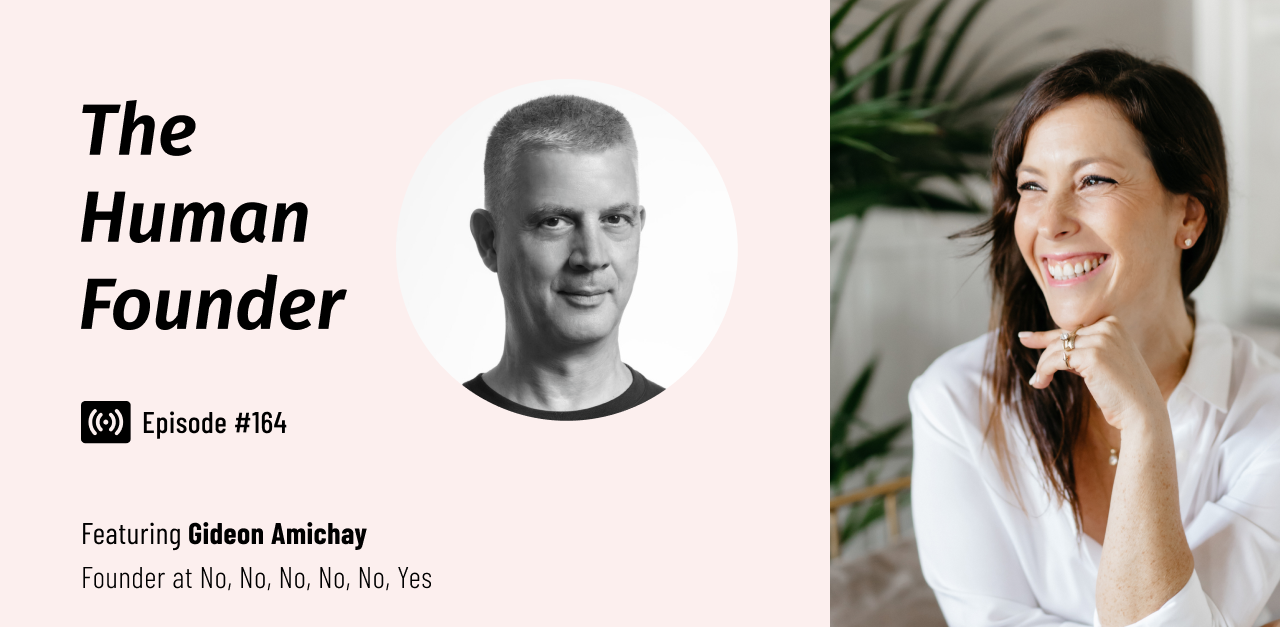
Episode
#164
HEB
No, No, No, No, No – Yes | Gideon Amichay: A Journey of Creativity, Persistence, and the Joy of Making
From Cartoonist to Creative Director: The Unplanned Path
Gideon Amichai never set out to become one of Israel’s leading figures in advertising. In fact, he actively tried to convince his teachers at Bezalel that he wouldn’t become one. His starting point was somewhere else entirely, as a cartoonist. The path from there into the heart of the advertising world was never linear or planned. It unfolded through experimentation, trial and error, and a deep inner listening.
What guided him, again and again, was a commitment to staying true to his passion — to what genuinely felt right, and just as importantly, to recognizing what didn’t. His driving force, as he describes it, is the ability to set goals that seem almost impossible and then move toward them step by step until they become real.
And when you speak with Gideon, it becomes instantly clear that you’re speaking with an entrepreneur — not of a tech startup, but of his own life. A growth mindset, creativity, persistence, and the willingness to reinvent himself aren’t just professional tools for him. They’re a way of living, guiding him repeatedly toward the less obvious path and helping him create his next “yes.”
The First Time Someone Said “Yes”
Gideon’s love for drawing began early. He grew up in a small apartment in Holon with large age gaps between siblings and built his inner world through drawing and sports. His notebooks were filled with sketches of sports cars; he knew brand names by the age of four or five, and one of his drawings was even featured on television.
In high school, after some of his work appeared in Maariv La’noar, he decided to raise the bar. He wanted the main newspaper. He submitted a cartoon to Maariv Sports, and it was published. That’s when the real test began.
For an entire season — 29 consecutive Saturdays — he drew a new cartoon every week, took bus line 92 to drop it off at the editorial office, then skipped school on Sundays to check if it was published. Week after week, nothing. No one told him he was being tested. No one promised it would pay off. At home, people asked why he kept going. And he simply kept going.
At the end of the season, the editors told him, “We wanted to see if you could sustain this for a full year. From now on, you’re the cartoonist for Maariv.” Looking back, it’s easy to recognize what we now call grit — the blend of deep passion with the ability to persist without any guarantee of a reward.
No, No, No, No, No — and Then Yes
Years later, after completing his MBA and deciding to open his own firm, Gideon realized that persistence wasn’t just a character trait. It was a method. Life, he learned, is built from long sequences of “no.” Not one or two. Sometimes five, six, seven. But almost always, somewhere inside the “no,” there is also a “but.” And that “but” becomes the opening.
He never treats a “no” as a final verdict. For him, it’s raw material — a transition point, an invitation to ask, “What’s the path to yes?” The less reasonable the challenge seems, the more potential he sees within it.
The New Yorker Dream and the Power of “No”
After his early success at Maariv, Gideon entered Bezalel determined to be a cartoonist, even as others told him he had far broader abilities. On a student exchange program in New York, he met one of The New Yorker’s cartoonists and heard a blunt sentence: “There’s no chance this will ever happen.” In that moment, the dream crystallized. It became the one thing he wanted most.
For a full year, he sent dozens of cartoons and received rejection after rejection. Eventually, he returned to Israel, completed Bezalel with a graduation project of ten standout drawings, and put the dream away.
Three years later, already working in advertising, he was sent to New York. Right before the flight, almost by accident, he grabbed the old envelope with those graduation drawings. This time, two cartoons were purchased by The New Yorker. A year later, they were published. The same drawings. The same creator. Entirely different circumstances — as if something that had been ready all along was simply waiting for its moment.
Years later, his book began selling at the MoMA Design Store in New York. That too had once been a dream others labeled unrealistic. And once again, he didn’t argue with the skepticism. He just kept working. Another distant goal. Another quiet “yes” born from many “no’s.”
Creativity as an Unfair Advantage
Gideon calls creativity an “unfair advantage” — the ability to connect two things that don’t seem to belong together and create something new. Creativity had always been there, but after earning his MBA, it took on a new purpose. Once he began speaking with CEOs in the language of brand equity, category leadership, and market value, creativity shifted from expression to strategy.
He learned to translate inspiration into a roadmap. Vision into metrics. Ideas into impact. Suddenly, it wasn’t just about beautiful drawings or clever concepts. It was about shaping the way a product, a company, or even a market is perceived.
Freedom, Responsibility, and the Space Between
Throughout the conversation, a recurring tension emerges between freedom and responsibility — the desire to create without limits alongside the need to hold structure, clients, teams, and commitments. It isn’t a perfect balance, and he doesn’t pretend it is. It’s a fluid movement: sometimes more freedom, sometimes more responsibility, sometimes forward momentum, sometimes pause.
Within this movement lies one consistent truth: the people who endure over time — who lead organizations, build companies, and drive meaningful initiatives — are the ones who genuinely love what they do. Real love for the work creates staying power. There’s no artificial romance here. There’s passion, fatigue, sacrifice, effort, and fulfillment — all at the same time.
the ability to act with passion but also to let go when needed.
A Journey With No Final Chapter
The journey Gideon describes is one of continuous learning, inner belief, creativity, and contradiction. Full of no’s — and also but’s. And eventually yes’s. You don’t always recognize them immediately. Sometimes they’re quiet, small, not dramatic. But they’re there.
He speaks honestly about the cost, the investment, and the sustained effort — about how it’s never truly easy, not at the beginning, not in the middle, and not even once you’re considered “successful.” And at the same time, he describes how alive it feels. How energizing. How deeply motivating.
Gideon’s path tells one clear story: the more devoted you are to what you do, the more willing you are to persist without applause, and the more room you make for contradiction — and as long as you actually enjoy the journey — the greater the chance that you’ll eventually meet your own “yes.” Not always immediately. But inevitably, in hindsight.
This conversation is an invitation to see entrepreneurship as a way of life — an ongoing choice to move, to persist, and to create. And when you look back, you suddenly see how all the dots connect.